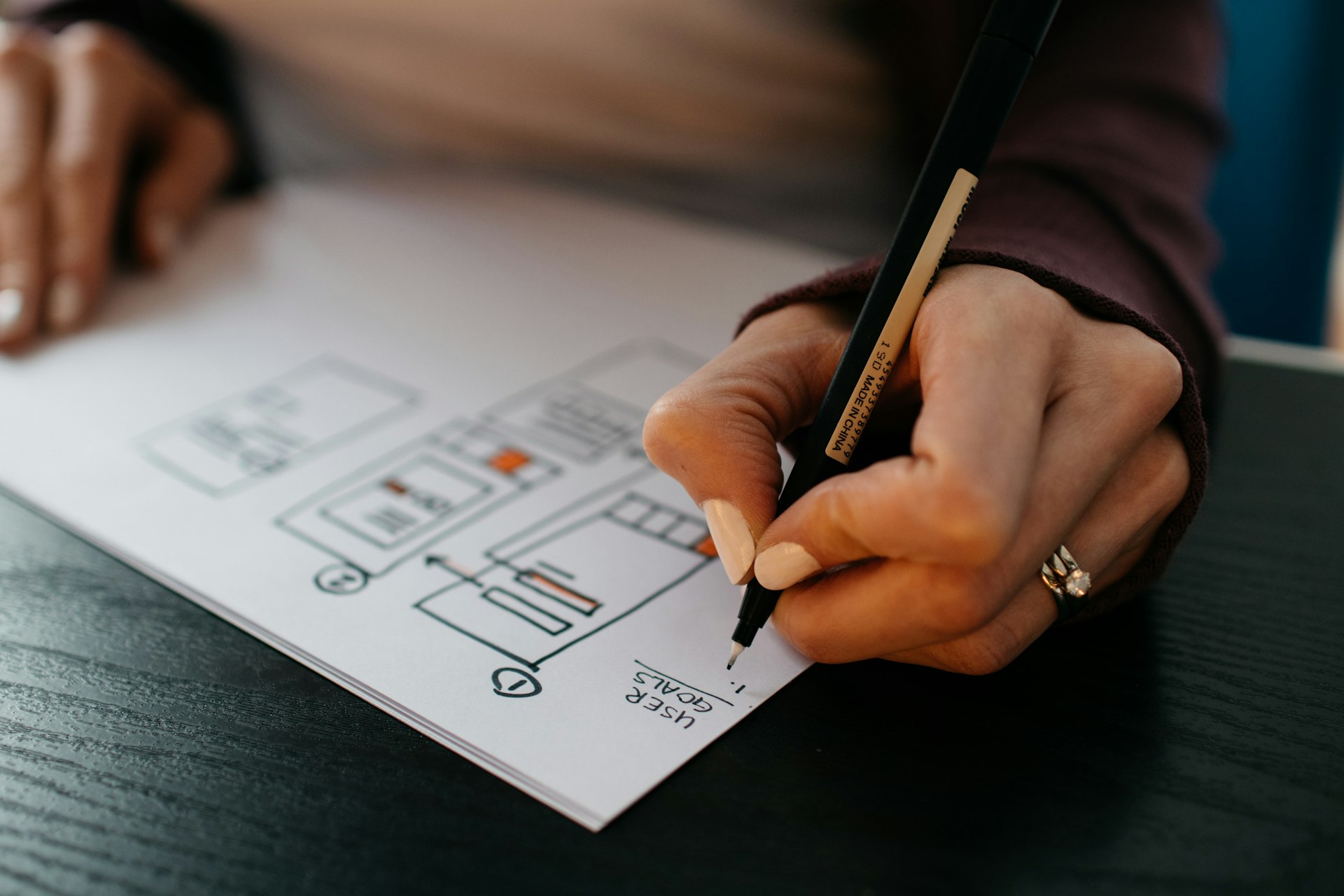

Design Thinking is a human-centered innovation methodology that enables solving complex problems creatively and collaboratively. Popularized by Stanford and IDEO, this approach structures the innovation process into five iterative stages: Empathy, Definition, Ideation, Prototyping, and Testing. In Morocco, more and more companies, startups, and institutions are adopting Design Thinking to transform their products, services, and processes.
What is Design Thinking?
Design Thinking is a pragmatic and iterative approach to problem-solving that places the end user at the heart of the process. Unlike traditional linear methods, Design Thinking promotes rapid experimentation, productive failure, and continuous improvement.
Core Principles
- Human-centered: Start from real user needs, not assumptions
- Collaborative: Involve multidisciplinary teams (designers, developers, marketers, business experts)
- Iterative: Rapid experimentation and learning loops
- Action-oriented: Prioritize doing over talking, prototypes over concepts
- Optimistic: Believe that a solution exists and can be found together
The 5 Stages of Design Thinking
1. Empathize
Deeply understand the needs, motivations, frustrations, and behaviors of end users. This phase employs qualitative research techniques to develop authentic empathy.
Tools and Techniques
- User interviews: Semi-structured conversations to explore lived experiences
- Ethnographic observations: Observe users in their real context of use
- Immersion: Put yourself in the user's shoes (shadowing, customer journey)
- Empathy maps: Visualize what the user says, thinks, does, feels
- Surveys and questionnaires: Collect complementary quantitative data
Deliverables
User insights, verbatims, field photos, observation notes, completed empathy maps.
2. Define
Synthesize collected insights to clearly formulate the problem to solve. This stage transforms raw observations into an actionable point of view (POV).
Tools and Techniques
- Personas: Create representative user archetypes
- POV formulation: "[User] needs [need] because [insight]"
- "How Might We?" question (HMW): Reframe the problem as an opportunity
- Affinity diagrams: Group insights by themes
- Jobs To Be Done: Identify the "jobs" the user seeks to accomplish
Deliverables
Personas, POV statement, prioritized HMW questions, clearly defined problem.
3. Ideate
Generate a maximum number of solution ideas, without judgment or censorship. The goal is quantity before quality: explore the field of possibilities divergently.
Tools and Techniques
- Brainstorming: Free group idea generation, rule: no criticism, all ideas are good
- Brainwriting (6-3-5): Individual writing then rotation of ideas between participants
- SCAMPER: Creativity techniques (Substitute, Combine, Adapt, Modify, Put to another use, Eliminate, Rearrange)
- Worst possible idea: Deliberately propose the worst ideas to unlock creativity
- Analogies and metaphors: Draw inspiration from other domains (biomimicry, other sectors)
- Storyboarding: Illustrate usage scenarios as comics
Convergence
After the divergent phase, convergence is needed: select the most promising ideas via criteria (impact, feasibility, desirability) and votes (dot voting, impact/effort matrix).
Deliverables
Hundreds of post-it ideas, selected ideas for prototyping, detailed concepts.
4. Prototype
Quickly materialize selected ideas as low-fi (low fidelity) or hi-fi (high fidelity) prototypes to make them testable. The goal: learn fast and cheap.
Types of Prototypes
- Paper prototypes (sketches): Quick hand drawings to test a concept
- Physical mockups: Cardboard, LEGO, modeling clay for tangible objects
- Wireframes: Digital interface diagrams (Balsamiq, Sketch, Figma)
- Clickable mockups: Interactive prototypes without code (Figma, Adobe XD, InVision)
- Concept videos: Filmed usage scenarios to test an experience
- Service blueprints: Mapping of interactions and back-office processes
- MVP (Minimum Viable Product): Simplified but functional version of the product
Prototyping Rules
- Do it quick and dirty (rough and dirty): Prioritize speed over perfection
- Test a precise hypothesis: Each prototype must answer a question
- Accept failure: A prototype that fails is a learning opportunity
Deliverables
Paper prototypes, wireframes, clickable mockups, videos, MVP.
5. Test
Confront prototypes with real users to validate or invalidate hypotheses. Feedback allows iteration and solution improvement.
Testing Methods
- Moderated user tests: Direct observation with test protocol and questions
- Unmoderated tests: Users test alone (UserTesting, Maze)
- A/B testing: Compare two versions to measure impact
- Feedback sessions: Present the prototype to a group and collect reactions
- Pilot / Beta: Limited deployment to early adopters
Key Questions
- Does the prototype solve the identified problem?
- Does the user understand the value proposition?
- Is the experience fluid and intuitive?
- What are the frictions and pain points?
- Would the user be ready to pay / use / recommend?
Iteration
Tests reveal insights that lead to iteration: return to one of the previous stages (redefine the problem, generate new ideas, improve the prototype) until reaching a satisfactory solution.
Deliverables
Test reports, user videos, improvement insights, iterated prototypes.
Design Thinking Tools
Physical Tools
- Colored post-its: For brainstorming, affinity sorting, voting
- Flipcharts / whiteboards: Visual collaboration support
- Thick markers: Quick sketching, readable from a distance
- Prototyping materials: Cardboard, paper, glue, tape, LEGO, Play-Doh
- Timers: Timeboxing to maintain rhythm
Digital Tools
- Miro / Mural: Online collaborative whiteboards for remote workshops
- Figma / Adobe XD: Interface design and interactive prototyping
- Notion / Airtable: Insights documentation, project management
- UserTesting / Maze: Remote user testing
- Typeform / Google Forms: Surveys and questionnaires
- Loom / Zoom: Recording test sessions
Facilitating a Design Thinking Workshop
Preparation
- Define the objective: What problem are we trying to solve?
- Select participants: Multidisciplinary team (6-12 people ideal)
- Plan the agenda: Strict timeboxing (e.g., 2h for ideation, 3h for prototyping)
- Prepare materials: Post-its, markers, supports, digital tools
- Book a space: Bright room with walls for posting, modular furniture
Typical Flow (1 day)
- 09:00-09:30: Introduction, ice-breaker, problem framing
- 09:30-11:00: Empathy Phase - share insights, interviews if needed
- 11:00-12:00: Definition Phase - personas, POV, HMW
- 12:00-13:00: Lunch break
- 13:00-15:00: Ideation Phase - brainstorming, convergence
- 15:00-17:00: Prototyping Phase - building prototypes
- 17:00-18:00: Testing Phase - presentation, feedback, iteration
- 18:00-18:30: Debrief, next steps
Key Roles
- Facilitator: Guides the group, ensures timing, manages dynamics
- Participants: Active contributors, bring business/technical/user expertise
- Decision-maker: Validates directions, decides in case of disagreement
- Observer: Takes notes, captures insights without interfering
Golden Rules
- Defer judgment: All ideas are good in the divergent phase
- Encourage wild ideas: Get out of the comfort zone
- Go for quantity: 100 ideas are better than 10
- Build on others' ideas: "Yes, and..." rather than "Yes, but..."
- Stay visual: Draw, stick, show rather than explain
- One conversation at a time: Active listening and respect for speaking turns
Design Thinking Use Cases
Digital Product Design
Create a mobile app, website, SaaS platform starting from real user needs. Design Thinking helps avoid the "genius product nobody uses" syndrome.
Customer Experience Improvement
Identify frictions in the customer journey (banking, insurance, e-commerce) and co-create solutions with customers themselves.
Digital Transformation
Support organizational change by involving employees in designing new processes and tools.
Service Innovation
Create new services (concierge, delivery, assistance) by identifying unmet market needs.
Strategy and Business Model
Rethink positioning, value proposition, distribution channels via collaborative strategic workshops.
Social and Societal Problems
Address complex issues (education, health, environment) by mobilizing collective intelligence of stakeholders.
Design Thinking vs Other Methodologies
Design Thinking vs Agile
Complementary: Design Thinking focuses on "what" (what problem to solve, what solution to create), while Agile focuses on "how" (how to develop iteratively). Combined, they form a powerful duo: Design Thinking upstream to define product vision, Agile for execution.
Design Thinking vs Lean Startup
Similarities: Iterative approaches, focus on rapid learning, validation through experimentation. Difference: Lean Startup is business-oriented (find a market, validate a business model), Design Thinking is user-oriented (solve a problem, create an experience).
Design Thinking vs Traditional Methods
Traditional methods (waterfall) follow a linear process: specifications → design → development → delivery. Design Thinking is iterative and puts the user at the center from the start, reducing the risk of building an unsuitable product.
Common Mistakes to Avoid
1. Skipping the Empathy Phase
Jumping straight to solutions without understanding users. Result: elegant solutions to problems that don't exist.
2. Falling in Love with Your Idea
Becoming attached to a solution before testing it and refusing negative feedback. Design Thinking requires humility and flexibility.
3. Prototyping Too Late or Too Perfect
Waiting to have "the right solution" before prototyping, or creating overly polished prototypes. Favor rapid and imperfect prototyping.
4. Not Involving Users
Testing among colleagues instead of confronting prototypes with real users. The most valuable insights come from the field.
5. Lack of Discipline
Not respecting timeboxing, drifting into sterile debates, not documenting insights. Design Thinking requires rigorous facilitation.
Design Thinking in Morocco
Banking Sector
Moroccan banks use Design Thinking to rethink their digital customer journeys, create new services (mobile payment, instant credit), and transform the branch experience.
Startups and Innovation
Moroccan startups adopt Design Thinking to quickly validate their ideas, pivot if necessary, and build user-centered products from the MVP.
Large Companies
Groups (telecom, insurance, industry) organize Design Sprints to innovate on their legacy products, improve operational efficiency, or explore new markets.
Public and Nonprofit Sector
Administrations and NGOs use Design Thinking to co-build public policies, improve citizen services, and address complex social issues.
How VOID Applies Design Thinking
Discovery Phase
We start each project with an in-depth research phase: user interviews, behavioral analyses, sector benchmarks. We create personas, map journeys, and identify innovation opportunities.
Collaborative Workshops
We facilitate Design Thinking workshops with your teams to co-create solutions. Our certified facilitators guide participants through the 5 stages, adapting tools to business challenges.
Rapid Prototyping
Our UX/UI designers transform ideas into testable prototypes in a few days: wireframes, clickable mockups, MVPs. We prioritize rapid iteration over perfection.
User Testing
We recruit representative panels, organize test sessions (moderated or unmoderated), analyze insights, and document learnings to guide iterations.
Agile Implementation
Once the solution is validated, our development teams (React, React Native, Drupal) take over to build the product in Agile mode, with short sprints and frequent releases.
Resources to Go Further
Reference Books
- "Design Thinking" by Tim Brown (IDEO): The Design Thinking bible
- "Sprint" by Jake Knapp (Google Ventures): 5-day Design Sprint methodology
- "Creative Confidence" by Tom & David Kelley (IDEO): Cultivating creativity
- "The Design of Everyday Things" by Don Norman: User-centered design principles
Training and Certifications
- Stanford d.school: Design Thinking training (bootcamps, workshops)
- IDEO U: Certifying online courses
- Interaction Design Foundation: Accessible UX/Design Thinking curriculum
Free Tools
- IDEO Design Thinking Toolkit: Templates and practical guides
- Google Design Sprint Kit: Complete sprint methodology
- Miro/Figma Templates: Ready-to-use canvas for workshops
Conclusion
Design Thinking is not a magic recipe, but a discipline that is practiced and improved with experience. By placing the user at the center, promoting collaboration, and iterating quickly, this methodology enables solving complex problems and innovating in a structured way. At VOID, we apply Design Thinking to every project to ensure that developed solutions meet real needs and create value. From strategic workshop to final product development, we support Moroccan and international companies in their user-centered innovation journey.
Related Articles
Need a Design Thinking Workshop?
Our certified facilitators help you innovate and solve your complex problems through collaborative workshops.
Contact Our Team